Restoring My Carl Malmsten Visingsö Chairs: Fine Woodworking & Upholstery
From learning fine woodworking at The Krenov School (College of the Redwoods) to studying furniture making at Capellagården in Sweden, this video is a look back at my journey as a maker and the process of reupholstering a pair of Carl Malmsten chairs that I made, 20 years later.
I reflect on learning to see the smallest details, blending sewing with woodworking, and embracing the pure love of craft.
Fine Woodworking
In the early 2000s, I had the good fortune to land myself a spot in the College of the Redwoods Fine Woodworking School (CR). I was 21 and completely green as a woodworker for which I compensated with boundless enthusiasm. When I applied and was accepted, I didn’t even know what some of the tools were on the recommended tool list, and I thought there was a typo in the class schedule. It said that class was held Monday through Saturday from 8-5. Surely they didn’t mean to say Saturday too?? They meant Saturday.
When I arrived there I thought I was pretty snazzy because I could read a tape measure and could see a quarter of an inch, an eighth of an inch, maybe even a sixteenth of an inch! When I left CR (which is now called The Krenov School) I could see 32nds and 64ths of an inch. I can see when a curve is fair, or when something is out of plumb. I’ve never been able to un-see things on such a granular level since. I learned to sharpen my vision there, along with a lot of tool blades. I learned to do things to the n’th degree, and while that is deeply satisfying, I was quite bewildered when school ended and I returned to the world where getting things within an inch seemed to be all that there was time or money for. I wouldn’t trade it though. I haven’t spent a lot of time in wood shops in recent years, but my love and care for working with my hands was fully realized at CR and it shows up in everything that I do.
Woodworking seems to attract certain types of people, and while I was an outlier there as a young woman, I found myself amidst very warm, down to earth people who endeavored to see and know the smallest details, and rise to the challenge of each moment with presence and precision- people with whom I could easily relate.
People would get bogged down in the weeds of all the small details of their work and one of my classmates liked to joke that “it’s not rocket science”. But one day another classmate chimed in that “actually, it’s just like rocket science. Fine woodworking and rocket scientists are just moving through long, detailed processes, that must be done correctly and in the right order.” Simple as that.
Capellagården
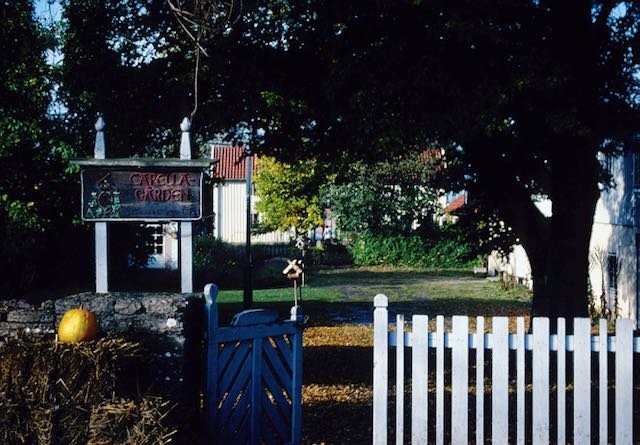
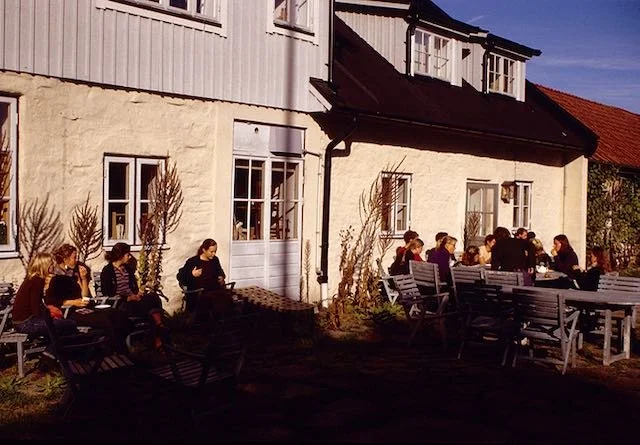
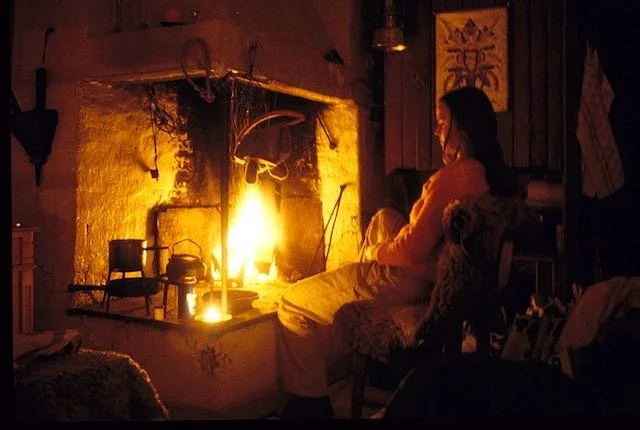
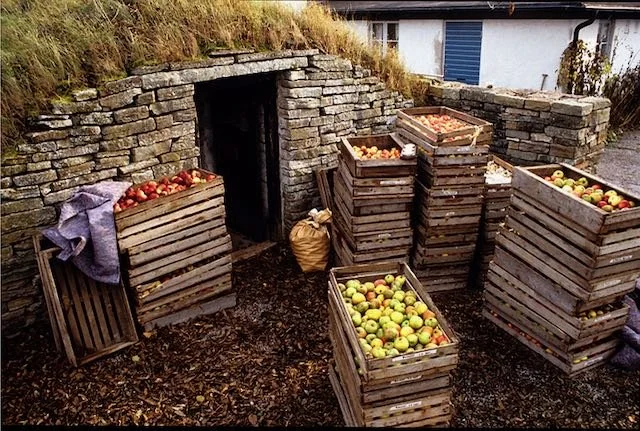
And as if it wasn’t already enough to live on the glittering coast in Northern California, and spend my time discussing wood movement and glue theory with some of the best woodworkers on the planet, I got to do a semester abroad with a tiny, wonderful craft school in Sweden called Capella Garden. This school was founded by Swedish furniture designer Carl Malmsten and taught furniture making, fibers arts, ceramics, and biodynamic gardening. It was situated on the shoulder of a small island off the southern coast of Sweden, surrounded by farmland, and hemmed in by endless stone walls. The campus was a cluster of cottages and old stone buildings- the dining hall originally had a thatch roof and was built in the 1600’s? 1700’s? I forget, but held a kind of age and history that was rather unfathomable to me as an American. The school was fully furnished by furniture that students had built. The tables and chairs in the dining hall were all hand made by students. And there was a huge cupboard in the dining hall filled with one-of-a-kind mugs made by students that we used to drink our coffee. All the furniture in my bedroom was wooden and made by hand. All the objects were so real, and human and lovely. It was magical. There were fruit trees and flowers growing everywhere, a big sod-roofed cellar full of carefully stored apples, potatoes and carrots. There was this humble plum tree there in an orchard guarded by geese that produced the most exotic fruits I have ever eaten in my life. They were the same shape, and just smaller than a hen’s egg, and they faded from purple to magenta to gold had a hazy purple blush on the skin. The fruit inside was absolute nectar of the gods, bright and syrupy sweet. I’ve never come across another plum like it.
The main events on the weekends were a wood-fired sauna, mushroom hunting, or walking alongside fields of onions and sugar beets to the bird sanctuary at the nearest shore. Despite being in a bilingual country, everyone mostly conversed in their native Swedish so I spent a lot of time in my own head, and at my workbench. I was often chided for working too much and too hard “you silly Americans” but I had this sort of fire burning in me. I had lots to learn and less time to learn it in.
Visingsö Chairs
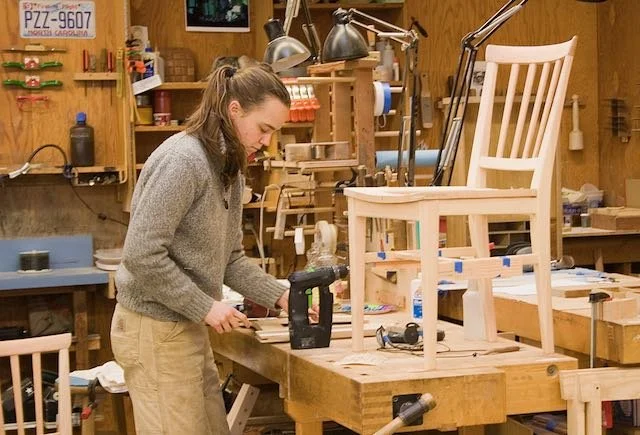
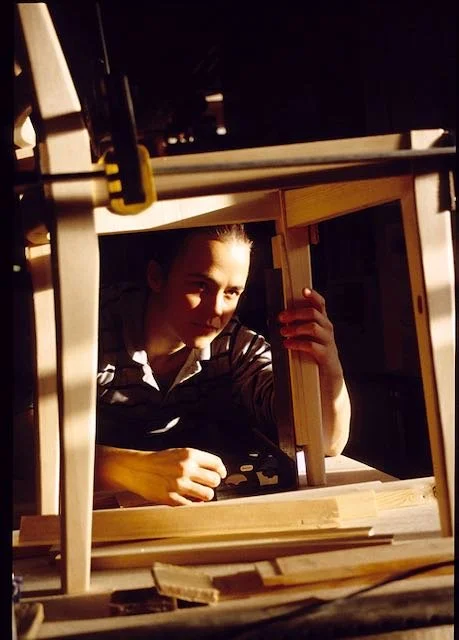
While there, I made this pair of Visingsö chairs, which were designed by Carl Malmsten. I went around to all the houses on campus to look at the different Malmsten chairs that outfitted the living spaces and fell in love with this design. It is warm and friendly to the eye, and comfortable to sit in and touch. I worked from plan drawings and was surprised by it’s complexity and illusion of simplicity. Nearly nothing is square in this chair is so my work was guided by a series of wedges that I made to follow the geometry of the design. That way, I could approach a cut with a given wedge on a square fence and come away with the correct angle on my cut. It was a major brain teaser navigating so many angles and their interactions.
These chairs are made from a Swedish pine called furu. I chose it because it was a wood native to Sweden and a common choice for this type of project. To look at it and work with it, it reminded me more of Douglas fir from the pacific northwest of the United States and Canada. It was harder, stronger, and more dense than any pine I have come across at home. Pine, spruce, birch and oak were Sweden’s primary native materials for woodworking. Despite being a densely forested country, its relative size and latitude limited the diversity of trees there.
One of the reasons that I chose to make chairs while at Capella Garden, aside from Malmsten’s skill and fame as a a chair designer, was that I wanted to bring my chairs home with me and I knew that a cabinet or larger piece of furniture would be tricky to transport. My strategy was to fully build my chairs with surfaces sanded smooth and ready for finish, but I didn’t glue a single piece together, and waited to upholster. When it was time to return to California, I built a cardboard box that was the maximum size that I could check on a plane and packed it with my chair parts along with other tools and personal items. I made a crude handle by tying some twine around the belly of the box and it was so heavy I could barely lift it. With all my might I would hoist it a few inches off the ground and, taking strained, shuffly baby steps. I could go five or six feet at time before I had to stop and rest. Luckily, there were few junctures on my journey home where I actually had to carry it by myself.
Upholstery
I was excited to have a fabric element and get to upholster these chairs. I came into woodworking by way of sewing. My path as a maker began working with fabric. The measure-cut-sew process of working with fabric parallels perfectly with woodworking. Going to furniture school felt like an expansion what I was already doing with fabric. Upholstering these chairs made me realize that there was a perfect marriage of the two if I wanted it, and I did for a time. After school I designed and built some upholstered furniture, and also made money reupholstering furniture. What’s funny is that being a seamstress led me into woodworking, but the woodworking eventually led me back to sewing. I had, at one time, a small upholstery shop set-up, and with my industrial sewing machine I started dabbling in making leather tool belts. Born of my own need of tool belt for my interests (sewing, woodworking and gardening) so that I could keep up with a scissor or pencil or pruner, I started putting some tool belt designs out into the world and they took off. I’ve been sitting at a sewing machine making tool belts for most of the last 15 years. But that is a story for another day.
When I upholstered these chairs for the first time at CR, I probably spent a week or two on the project. Obsessing over every staple placement, doing and re-doing the work wanting it to be absolutely perfect. That was kind of the vibe at CR though. If you weren’t doing a deep dive, then what were you really doing?? Some people thrived under the pressure to meet the high standard of craftsmanship that was expected, but I watched others absolutely unravel. I fell somewhere in between. Reupholstering these chairs now, some 20+ years later, I was noticing as I did the work the way my mind and hands were able to flow confidently over the work, knowing which parts mattered, and not getting bogged down by the minutiae. I noticed that when I did this the first time, I was desperately precious over all the details. I was able to get the job done in a day, and do it well.
On the underside of this chair, I chose to not tack on the usual black cambric to hide the undercarriage of the chair, but instead I took the time to hand sew a beautiful fabric in instead. This is a detail that basically no one will ever see or know about, but I know its there, and it makes me happy. I do it for the love of craft, and the love of making.
There was a Carl Malmsten quote that I saw at Capella Garden that has followed me ever since.
“As a maker, my hands are my lanterns. They illuminate my path.”